

Easy Invoice & Estimate Maker
Easy Expense Tracker
I approached Easy Invoice & Estimate Maker as a practical business tool rather than another app I would open only when something goes wrong. Its purpose is straightforward: help me prepare professional invoices and estimates from a phone, then keep the paperwork moving while I am away from a desk. That focus makes it especially relevant to freelancers, tradespeople, consultants, and small operators who need a quicker alternative to handwritten documents or a full accounting suite.
The app is free to install and is listed for everyone, which makes it easy to try without committing money at the beginning. It comes from Easy Expense Tracker, has reached over one hundred thousand installs, and holds a 4.8 average from roughly three thousand six hundred ratings. Those figures suggest that it has found a useful place among people who want simple invoicing rather than an elaborate finance platform. My overall impression is positive, but the real question is not whether it can make an invoice. It is whether its workflow remains comfortable when I am working quickly, using a small screen, or trying to manage business paperwork with limited time and attention.
How clearly the app supports everyday invoicing
Readable screens and a focused path from estimate to payment
The strongest part of the experience is its narrow purpose. Instead of forcing me through a large accounting dashboard, the app is centered on the documents a small business actually sends: invoices and estimates. That makes the first-use experience less intimidating for someone who understands their work well but does not enjoy bookkeeping. I can think in terms of a customer, a job, a price, and a payment request rather than learning an entire financial system before creating anything useful.
That simplicity also helps readability. A focused invoice tool has fewer competing destinations than a general business-management app, so I spend less time deciding where to begin. For a self-employed person checking details between appointments, this matters more than a long list of advanced options. The app’s store summary, “Get Paid Faster with Professional Invoices,” describes the practical aim accurately without making it sound like a replacement for every financial task.
I would still approach the interface with a little care on a phone. Invoice work involves names, addresses, descriptions, quantities, rates, taxes, and totals, so even a clean layout can become tiring when a document is long. My useful habit is to prepare the customer and line-item information before starting, then review the final document slowly instead of treating the first completed screen as proof that everything is correct. A readable form is helpful, but it cannot prevent a rushed user from entering the wrong rate or omitting an important detail.
Related News

Why WhatsApp Messenger Still Makes Everyday Communication Feel Easy

Jurassic World: The Game Is the Better Dino Tycoon for Strategic Players

Threads in Real Life: Who Should Join, Lurk, or Leave

How SHEIN Turned Shopping Into an Endless Content Feed

How to Make Fortnite Feel Smarter on Mobile

Should You Switch to Microsoft Outlook on Mobile?
Why estimates are more useful than they first appear
The estimate side gives the app more value than a basic receipt maker. I can use an estimate as a boundary-setting document before work begins, especially when a client needs to understand the expected cost before approving a job. That creates a cleaner sequence: describe the proposed work, send the estimate, complete the job, and turn the agreed information into an invoice when payment is due.
For a cleaner or repair technician, a realistic workflow might be handled from a driveway. I could write an estimate after inspecting a property, include separate items for labor and materials, and send it while the details are fresh. Later, I could prepare the invoice without reconstructing the job from memory. The benefit is not just speed. Keeping the estimate and invoice connected in my own working process reduces the chance of changing a price casually or forgetting what was promised.
This is also useful for clients who need a document they can read before making a decision. A professional-looking estimate can explain the scope more clearly than a text message with a single total. The trade-off is that the app is best when the job is relatively clear. If every project requires complex phases, extensive approvals, or detailed cost accounting, I would want a more specialized system rather than stretching a lightweight invoice app beyond its natural role.
Gallery
Navigation that suits different levels of technical confidence
I see this app working well for people who are comfortable using a smartphone but do not want to become accounting-software experts. A sole trader can concentrate on the customer and the work instead of navigating a maze of financial reports. Someone who is new to invoicing can also begin with a familiar document-based approach: create, check, and send.
That does not mean every user will find the experience equally effortless. People who need large text, strong visual separation, or extra time to confirm each field should test the editing flow carefully on their own device. The app is available for Android devices running version 8.0 or later, so compatibility is broad but not universal. A phone with a small display, aggressive text scaling, or an older operating system may make the experience less comfortable than a newer device.
The most accessible workflow is the one I make predictable before I need it. I would create a sample estimate, inspect the document, and decide on a standard order for entering information. That small preparation step helps users with attention difficulties, memory limitations, or stress because it turns an open-ended task into a repeatable routine. It also makes mistakes easier to spot before a real customer sees the result.
Motor and sensory considerations during document creation
Invoice entry can be demanding for anyone with limited dexterity because it involves repeated tapping, keyboard use, scrolling, and precise selection. The app’s phone-first format is convenient, but convenience is not the same as low physical effort. If I were using one hand, working outdoors, or dealing with hand fatigue, I would avoid composing a long document in a hurry. A short, prepared list of common services would make the process less repetitive, although I would not assume that every desired shortcut is available without checking the current version.
Voice input at the device level may help some users enter descriptions, but I would always proofread names, measurements, and amounts. Automatic transcription is particularly risky for financial information. A single misplaced digit can matter more than several seconds saved during entry. For users with tremors or reduced precision, reviewing the final total is essential, and using a stable surface rather than holding the phone in the air can make the task less frustrating.
Sensory comfort depends heavily on the phone and the person. Bright outdoor light can make any mobile form harder to inspect, while glare may hide small details on a document preview. I would enlarge the device text where possible, increase screen brightness only when necessary, and review the invoice in a calmer setting before sending it. Users who rely on screen readers or highly customized display settings should evaluate the actual fields and controls on their device rather than assuming that a simple app will automatically meet every need.
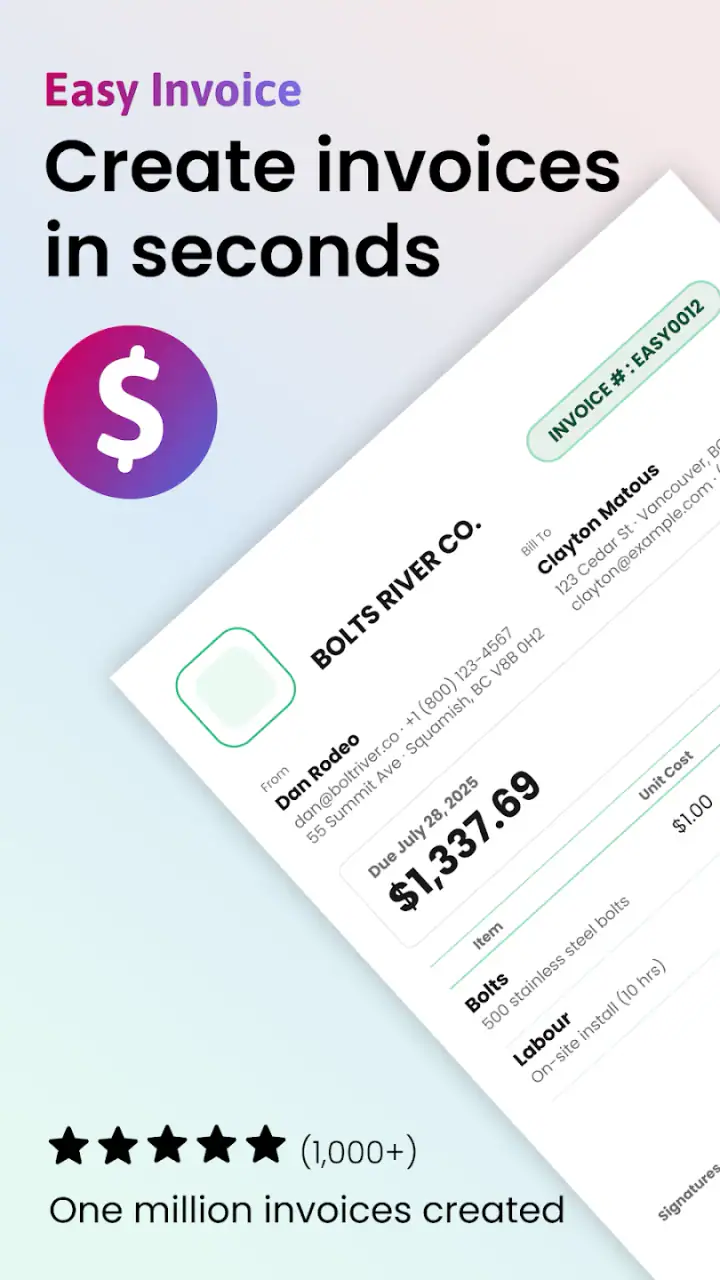
There is an important distinction between a professional document and a visually busy one. A client may appreciate an invoice that presents the business identity, work description, amount, and payment expectation in an orderly way. I found that restraint is valuable here: adding every possible detail can make a document harder to scan, especially for a client reading it on a phone. I would keep descriptions specific but compact, separate unrelated work into different items, and check that the final total stands out clearly.
Using it in noisy, mobile, or interrupted situations
The app makes the most sense for people whose office is wherever the work happens. A photographer could prepare an estimate after discussing a project, a tutor could invoice a family after a block of lessons, and a market seller could organize business charges without carrying a laptop. In these situations, the advantage is not only portability. It is the ability to capture the financial document close to the moment when the agreement is made.
However, mobile work introduces its own barriers. A noisy workshop, a moving vehicle, poor lighting, or a weak attention span can turn a simple form into a mistake-prone task. I would not create a final invoice while walking between jobs or while a customer is waiting impatiently. Instead, I would record the essential details in a consistent note or use a draft-like process if available, then complete the document when I can concentrate. The app helps bring invoicing closer to the job, but it does not remove the need for a safe and focused moment.
This is where the app can be more inclusive than a desktop-only alternative, even without making any formal accessibility claim. A person who cannot comfortably sit at a desk for long periods may find a short phone session easier. Someone who works irregular hours can handle paperwork after a visit rather than waiting until they return to an office. The benefit is contextual: the same small screen that feels restrictive at a desk can feel liberating when a laptop is impractical.
Where a simple tool may not be enough
The main limitation is scope. Easy Invoice & Estimate Maker is a business app built around invoices and estimates, not a complete accounting environment. If I needed deep inventory management, payroll, bank reconciliation, complex tax reporting, or multi-person approval workflows, I would compare it with established accounting software before relying on it. Those alternatives usually demand more setup and may feel excessive for a solo operator, but they become worthwhile when the business has complicated records or several people handling finances.
There is also a cost boundary to consider. The app is free, yet it includes in-app purchases ranging from $2.49 to $249.99 per item. That wide range means I would inspect the purchase screen carefully and understand which tools are included in the free experience before building a business process around a paid capability. A free starting point is useful, but “free to install” does not necessarily mean that every workflow a growing business wants will remain free.
The current version is 4.42.0, which shows that the app has continued to receive version updates since its release on October 9, 2020. Even so, I would keep my own records outside the app when the documents are important. Saving copies in an organized business folder, checking contact details before sending, and retaining evidence of what was issued are sensible habits for any invoicing method. A mobile app can make creation easier, but it should not be the only place where critical business history exists.
Another potential barrier affects users who need advanced collaboration. A solo professional may not miss shared access, while a small team might quickly need permissions, approval steps, or a central customer record. If several people create documents for the same business, I would test whether the app’s workflow matches that responsibility structure before making it the team’s main system. A tool that is wonderfully direct for one person can become awkward when several people need to edit, review, and track the same information.
Practical habits that make the experience more inclusive
I would begin by creating a small set of consistent service descriptions. Even if the app does not eliminate repeated entry, having a personal naming system reduces cognitive load. “Initial consultation,” “materials,” and “installation” are easier to review than improvised wording that changes from one document to another. Consistency benefits clients too, particularly those who need clear, predictable information rather than dense paragraphs.
Next, I would separate preparation from verification. During preparation, I would enter the customer and job details without trying to answer messages or hurry the process. During verification, I would check the recipient, dates, item descriptions, amounts, and final total in that order. This two-pass method is a useful safeguard for users with attention challenges, fatigue, or interruptions, and it is valuable even for people who consider themselves careful.
I would also use estimates as a communication aid, not merely as a preliminary invoice. A clear estimate gives a client an opportunity to ask about scope before the work is complete. If the job changes, I would make the revised expectation explicit rather than quietly changing the final amount. That practice improves trust and makes the app’s document workflow more meaningful than simply producing attractive paperwork.
Finally, I would decide in advance where completed documents belong. A simple folder structure by customer or month can make later retrieval much easier. This is particularly helpful for users who find open-ended digital organization stressful. The app handles document creation, while a separate, familiar storage habit handles continuity. Keeping those responsibilities clear prevents the phone from becoming a confusing pile of one-off files.
Who should use it, and who should choose something else
I would recommend this app to a freelancer who wants to send a polished invoice without learning a full bookkeeping platform. It is also a sensible candidate for a tradesperson, consultant, tutor, cleaner, designer, or other independent worker whose financial documents are relatively straightforward. The free entry point lowers the risk of trying it, and the Everyone content rating makes it suitable for a broad audience from an age-classification perspective.
I would be more cautious for a business that has several staff members, complicated tax obligations, stock that must be tracked closely, or a requirement for detailed financial reporting. In those cases, a dedicated accounting service may be better even if it takes longer to learn. I would also hesitate if a user depends on highly customized accessibility behavior and cannot comfortably operate the app’s fields on their phone. The right choice should be based on the actual editing experience, not just the attractive promise of mobile convenience.
Compared with handwritten invoices, this app should offer a more orderly and repeatable approach. Compared with a spreadsheet, it is likely to feel more purpose-built for sending documents, while a spreadsheet may provide greater freedom for unusual calculations. Compared with a full accounting suite, it is easier to approach but narrower in scope. That middle position is its identity: it is not trying to manage an entire company, and I think it works best when I respect that boundary.
My inclusive verdict after using it as a small-business tool
Easy Invoice & Estimate Maker succeeds because it addresses a real point of friction for independent workers: turning completed work or a proposed job into a document a customer can understand and act on. Its focused business category, free installation, and strong 4.8 average make it an appealing first step for someone who wants professional invoicing from a phone. The developer, Easy Expense Tracker, has kept the product centered on a practical need rather than burying that need under unrelated features.
For accessibility and inclusion, I see meaningful situational strengths rather than a universal solution. A phone can help people who move between locations, work irregular hours, or cannot spend long periods at a desk. Clear routines, careful review, device-level display adjustments, and sensible document organization can make the workflow more manageable for different abilities. At the same time, small screens, repeated data entry, sensory distractions, and the need for advanced business controls remain genuine considerations.
My recommendation is to test one complete estimate-to-invoice routine before depending on it. Enter a realistic customer, inspect the resulting document, check how comfortable the controls feel with your preferred device settings, and understand which optional purchases matter to your work. If that trial feels calm and repeatable, this is a useful companion for a solo business. If your operation needs shared accounting, complex reporting, or highly specialized support, I would choose a broader platform instead. For straightforward mobile invoicing, its simplicity is a strength; for complex administration, that same simplicity becomes the limit.
FAQs for Easy Invoice & Estimate Maker
What is Easy Invoice & Estimate Maker used for?
Easy Invoice & Estimate Maker is designed to help freelancers, contractors, small businesses, and service providers create professional estimates and invoices from a phone or tablet. You can enter customer details, add products or services, apply taxes or discounts, calculate totals, and send documents digitally. It is particularly useful for businesses that need a simple way to manage billing while working away from a desktop computer.
Can I customize invoices and estimates with my business information?
Yes, the app generally allows you to personalize documents with important business details such as your company name, logo, address, phone number, email address, and payment information. Depending on the version and available settings, you may also be able to adjust colors, notes, invoice numbering, tax fields, and payment terms. It is worth reviewing the template options before relying on the app for a large volume of branded documents.
Can I send invoices and estimates directly to customers?
Easy Invoice & Estimate Maker is built for sharing documents quickly after they are created. Once an invoice or estimate is prepared, you can usually preview it and send it as a PDF or through compatible sharing options such as email or messaging applications. This makes it convenient for on-site work, although the exact sharing methods may depend on your device, operating system, and the permissions granted to the app.
Does the app track payments and outstanding invoices?
The app may provide tools for organizing invoices, checking their status, and recording whether a customer has paid, depending on the edition and subscription plan. These features can help you distinguish between drafts, sent documents, overdue balances, and completed payments. However, users should not assume that it replaces full accounting software, bank reconciliation, or automated payment processing unless those functions are specifically listed in the app.
Is Easy Invoice & Estimate Maker free to download and use?
The application may be available to download at no initial cost, but some features can require in-app purchases, a subscription, or an upgraded plan. Restrictions may apply to the number of invoices, available templates, branding options, cloud backups, exports, or customer records. Before creating important business documents, check the current pricing, trial conditions, renewal terms, and cancellation policy shown on the official Google Play or App Store listing.
Pros
- Create professional invoices and estimates directly from your phone.
- Quickly reuse customer and item details to speed up billing.
- Useful templates help maintain a consistent business appearance.
- Track invoice status and keep payment records organized.
- Suitable for freelancers and small businesses with mobile workflows.
Cons
- Advanced accounting and inventory features may be limited.
- Some useful tools may require a paid subscription or upgrade.
- Manual data entry can become time-consuming for many products.
- Customization options may not satisfy businesses needing branded layouts.
- Cloud backup and synchronization depend on account and internet access.


